
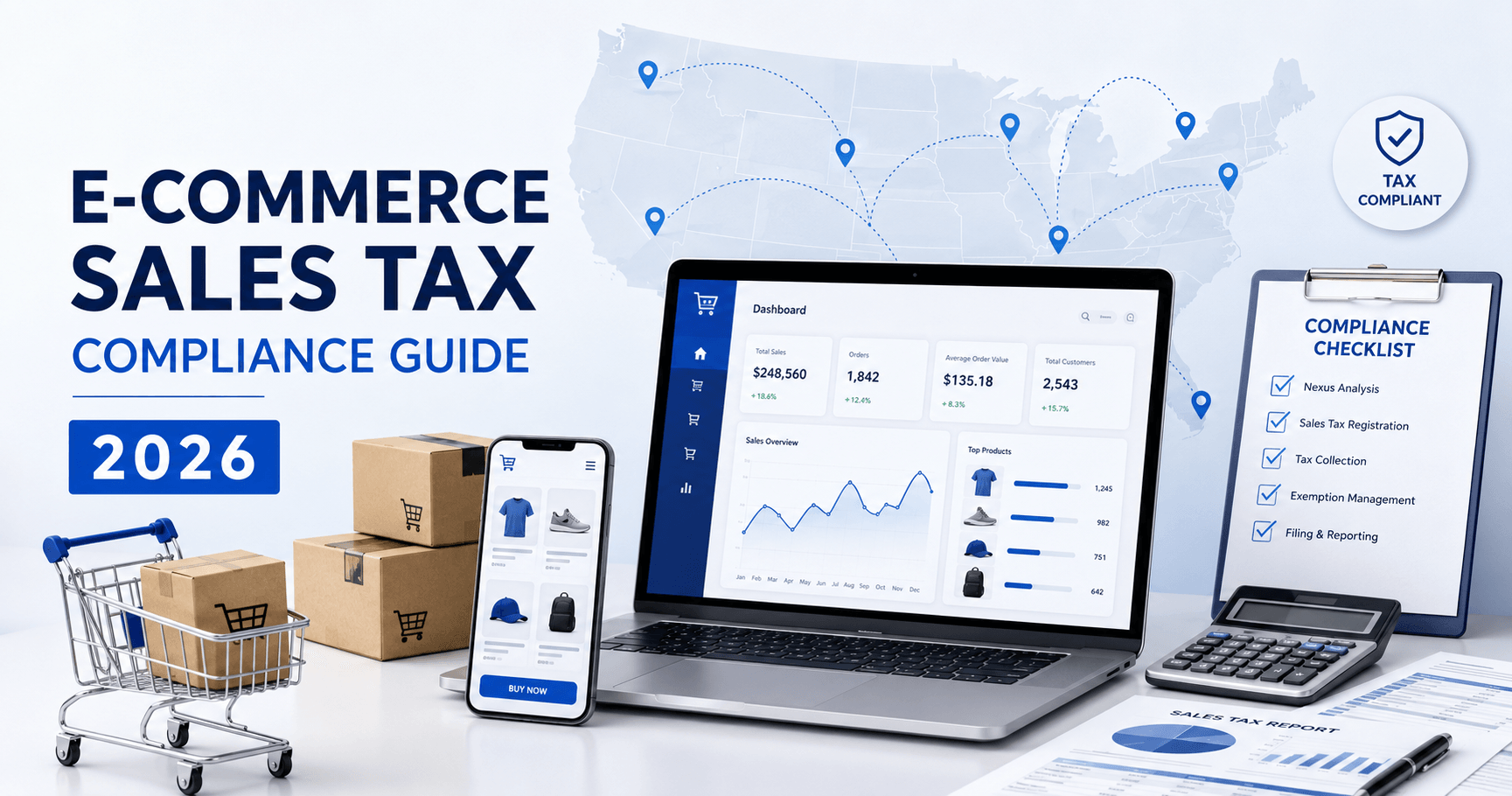
Sales Tax Compliance for E-Commerce Businesses in 2026: A Practical Guide for Online Sellers
Learn how e-commerce businesses can stay sales tax compliant in 2026. This guide explains economic nexus, marketplace facilitator rules, Shopify and website tax settings, product taxability, registrations, filings, backfilings, and common mistakes online sellers should avoid.
Quick Answer
E-commerce sales tax compliance means registering in the required states, collecting the correct sales tax, filing returns on time, and reconciling tax collected across platforms like Shopify, Amazon, Walmart, Etsy, and other online stores. Online sellers should regularly review economic nexus, product taxability, marketplace sales, website sales, and filing obligations to avoid penalties and audit exposure.
Article Summary
E-commerce sales tax compliance in 2026 requires online sellers to monitor economic nexus, marketplace facilitator rules, product taxability, registrations, filings, and tax settings across multiple states. This guide explains how Shopify, Amazon, marketplace, and direct website sellers can reduce sales tax risk, avoid penalties, and stay compliant as they scale.
Key Takeaways
- 1E-commerce businesses may have sales tax obligations even without physical presence in a state.
- 2Economic nexus rules require online sellers to monitor sales by state regularly.
- 3Marketplace facilitator rules do not always remove all seller compliance responsibilities.
- 4Shopify, WooCommerce, BigCommerce, and other platforms must be configured correctly for tax collection.
- 5Product taxability varies by state, especially for clothing, supplements, digital products, software, food, and bundled items.
- 6Registered sellers may still need to file zero returns even when no tax is due.
- 7Sales tax collected should be reconciled with returns filed to avoid underpayment, overpayment, and notices.
- 8A proactive sales tax review is usually easier and less costly than fixing past non-compliance.
E-commerce has made it easier than ever to sell across the United States. A business can launch on Shopify, Amazon, Walmart, Etsy, WooCommerce, or BigCommerce and reach customers in multiple states within days.
But with that growth comes a serious compliance challenge: sales tax.
For many online sellers, sales tax is no longer a simple “collect in your home state” issue. Today, e-commerce businesses may be required to register, collect, file, and remit sales tax in multiple states depending on where they sell, how much they sell, what products they sell, where inventory is stored, and whether they sell through marketplaces or their own website.
At SGM Tax Services, we work with e-commerce businesses, Shopify sellers, marketplace sellers, SaaS businesses, and multi-state companies to simplify sales tax compliance and reduce exposure.
This guide explains what online sellers need to know about sales tax compliance in 2026.
What Is Sales Tax Compliance for E-Commerce Businesses?
Sales tax compliance means correctly managing every step of your sales tax obligation, including:
· Monitoring economic nexus thresholds
· Registering in the required states
· Setting up tax collection correctly in your online store
· Applying the right taxability rules by product
· Collecting exemption certificates where applicable
· Filing returns on time
· Remitting tax payments to the correct states
· Reconciling tax collected vs. tax filed
· Responding to notices, penalties, or audit inquiries
For e-commerce businesses, sales tax compliance becomes more complex because each state has its own rules. A product that is taxable in one state may be exempt or partially taxable in another. Shipping charges may be taxable in one state and non-taxable in another. Marketplace sales may be handled by Amazon or Etsy in some situations, but direct website sales may still create separate obligations for the seller.
That is why a proper sales tax compliance process is essential for any growing online business.
Why E-Commerce Sales Tax Has Become More Complicated
Years ago, many businesses only collected sales tax in states where they had a physical location, employees, warehouse, or other physical presence.
That changed after the landmark South Dakota v. Wayfair decision. Today, most sales tax states can require remote sellers to collect and remit sales tax if they cross that state’s economic nexus threshold.
This means an e-commerce business may create sales tax obligations simply by selling enough into a state even without an office, employee, or warehouse there.
For example, a seller based in Florida may still need to collect sales tax in California, Texas, New York, Illinois, or other states if its sales cross the applicable threshold.
For online sellers, the most common sales tax triggers include:
1. Economic nexus
You exceed a state’s sales or transaction threshold.2. Physical nexus
You have inventory, employees, contractors, trade show activity, or other physical presence in a state.3. Marketplace sales
You sell through Amazon, Walmart, Etsy, eBay, or other marketplaces.4. Direct website sales
You sell through Shopify, WooCommerce, BigCommerce, Magento, or your own website.5. Product taxability differences
Your products are taxed differently across states.6. Inventory stored in third-party warehouses
FBA or 3PL inventory may create physical nexus in some states.
Economic Nexus: The Biggest Sales Tax Issue for Online Sellers
Economic nexus is one of the most important concepts for e-commerce businesses.
In simple terms, economic nexus means your sales activity in a state is high enough that the state can require you to collect and remit sales tax.
Each state has its own threshold. Some states use a sales dollar threshold, some use a transaction threshold, and some consider taxable sales, gross sales, marketplace sales, or other measurements differently.
This is where many e-commerce businesses make mistakes.
A common assumption is:
“We are not physically located in that state, so we do not need to register there.”
That is no longer correct.
If your business sells into multiple states, you should review your sales by state regularly. For many growing online businesses, this should be done at least quarterly. For fast-growing sellers running paid ads, influencer campaigns, marketplace promotions, or seasonal sales, monthly monitoring may be more appropriate.
Marketplace Facilitator Rules: Does Amazon or Etsy Handle Everything?
Marketplace facilitator laws generally require marketplaces such as Amazon, Etsy, Walmart, and eBay to collect and remit sales tax on behalf of sellers for marketplace transactions.
This is helpful, but it does not always eliminate your compliance responsibilities.
Many sellers make this mistake:
“Amazon collects sales tax, so we do not have any sales tax responsibilities.”
That may not be fully correct.
You may still need to consider:
· Whether marketplace sales count toward economic nexus thresholds
· Whether you also sell through your own Shopify or website
· Whether you are required to register even if the marketplace collects tax
· Whether zero returns are required after registration
· Whether inventory stored in a marketplace warehouse creates physical nexus
· Whether marketplace and direct sales must be reported differently
If you sell only through marketplaces, your obligations may be simpler. But if you sell through both marketplaces and your own website, your risk increases significantly.
For example:
· Amazon may collect tax on Amazon orders.
· Shopify may not collect correctly unless your tax settings are configured.
· Wholesale or exempt customer sales may require exemption documentation.
· Some states may still expect registration or reporting depending on your facts.
That is why marketplace sellers should not rely only on platform settings.
Shopify, WooCommerce, and Direct Website Sales: Why Setup Matters
If you sell through Shopify, WooCommerce, BigCommerce, Magento, or a custom website, your tax setup is critical.
Many e-commerce sellers assume their platform automatically handles everything. In reality, your platform only works properly when the correct settings, registrations, tax categories, and collection rules are configured.
Common setup issues include:
· Tax collection not enabled in registered states
· Collection enabled in states where the business is not registered
· Products assigned to incorrect tax categories
· Clothing, food, supplements, software, digital products, or medical items classified incorrectly
· Shipping tax settings not reviewed by state
· Marketplace and website sales not reconciled
· Exempt customers not properly documented
· Tax collected but not filed
· Tax filed but not reconciled to actual collections
Incorrect tax setup can create two types of risk:
1. Under-collection risk
You did not collect enough tax and may need to pay it out of pocket.2. Over-collection risk
You collected tax incorrectly and may need to refund customers or report it properly to the state.
Both situations can create penalties, notices, customer dissatisfaction, and audit exposure.
Product Taxability: Not Every Product Is Taxed the Same Way
E-commerce sales tax compliance is not just about where you sell. It is also about what you sell.
Different states tax products differently. Examples include:
· Clothing
· Food and beverages
· Supplements
· Cosmetics
· Medical products
· Digital products
· Software and SaaS
· Books and educational materials
· Subscription boxes
· Bundled products
· Shipping and handling fees
A product may be fully taxable in one state, exempt in another, and partially taxable in a third state.
This is especially important for businesses selling:
· Apparel
· Health and wellness products
· Beauty products
· Digital downloads
· Online courses
· SaaS subscriptions
· Mixed bundles
· Food or beverage products
· Medical or lab-related products
If your product taxability is wrong, even the best tax software may calculate tax incorrectly.
Tax automation tools are powerful, but they still require proper product mapping, tax codes, state registrations, and expert review.
AI, Automation, and Sales Tax: Helpful but Not a Complete Solution
In 2026, many e-commerce businesses are using AI, automation, and tax software to improve operations. These tools can help with data processing, transaction mapping, tax calculation, reporting, and exception review.
However, AI and automation cannot fully replace sales tax expertise.
Why?
Because sales tax compliance requires judgment. For example:
· Is the product taxable or exempt in a specific state?
· Is the seller required to register?
· Should marketplace sales be included in the threshold calculation?
· Is the tax collected correctly?
· Are backfilings or voluntary disclosure options needed?
· Should collection begin immediately or after registration is completed?
· Are exemption certificates valid and properly maintained?
Automation can help calculate tax, but it does not always determine the correct compliance strategy.
The best approach is a combination of:
· Strong tax technology
· Accurate product taxability mapping
· Regular nexus monitoring
· Monthly reconciliation
· Expert review
· Timely filing and payment controls
Sales Tax Compliance Checklist for E-Commerce Businesses
Use this checklist to evaluate whether your business is sales tax compliant.
1. Nexus Review
· Have you reviewed sales by state?
· Have you checked economic nexus thresholds?
· Have you reviewed physical presence, inventory, employees, contractors, and trade shows?
· Have you considered FBA or 3PL warehouse locations?
· Have you reviewed marketplace and direct sales separately?
2. Registration Review
· Are you registered in all required states?
· Are you collecting tax only after proper registration?
· Are there any states where backfilings may be required?
· Are there any states where a voluntary disclosure agreement may be beneficial?
3. Tax Settings Review
· Are Shopify, WooCommerce, BigCommerce, Amazon, or other platform settings configured correctly?
· Are tax categories mapped correctly?
· Is shipping taxability reviewed?
· Are marketplace and website sales separated properly?
· Are exempt sales supported with valid certificates?
4. Filing Review
· Are returns filed on time?
· Are zero returns filed where required?
· Are marketplace sales reported correctly?
· Are tax collected and tax remitted reconciled?
· Are notices and penalties tracked?
5. Ongoing Compliance Review
· Do you review nexus monthly or quarterly?
· Do you update tax settings when adding new products?
· Do you review state law changes?
· Do you maintain exemption certificates?
· Do you have a process for notices and audits?
If you answered “no” or “not sure” to any of these questions, your business may have sales tax exposure.
Common Sales Tax Mistakes E-Commerce Businesses Make
Here are some of the most common mistakes we see with online sellers:
Mistake 1: Waiting Too Long to Review Nexus
Many businesses review nexus only after crossing major revenue milestones. By then, they may already have historical exposure in multiple states.
Mistake 2: Assuming Marketplace Sales Solve Everything
Marketplace facilitator rules are helpful, but they do not always eliminate registration, reporting, or direct website obligations.
Mistake 3: Enabling Tax Collection Without Registration
In many cases, businesses should register before collecting tax. Collecting tax without proper registration can create compliance issues.
Mistake 4: Not Filing Zero Returns
Once registered, many states expect returns even when no tax is due. Missing zero returns can trigger penalties and notices.
Mistake 5: Using Incorrect Product Tax Codes
Wrong tax codes can lead to over-collection or under-collection. This is especially risky for clothing, supplements, food, software, digital products, and bundled items.
Mistake 6: Not Reconciling Tax Collected vs. Tax Filed
Your tax collected in Shopify, Amazon, Stripe, PayPal, or other systems should be reconciled with the returns filed. Without reconciliation, errors can go unnoticed for months.
Mistake 7: Ignoring Notices
State notices should be reviewed quickly. A small notice can become a larger issue if ignored.
When Should an E-Commerce Business Register for Sales Tax?
An e-commerce business should consider sales tax registration when:
· It crosses a state’s economic nexus threshold
· It has inventory in a state
· It has employees, contractors, or representatives in a state
· It attends trade shows or events in a state
· It sells taxable products directly to customers in a state
· It collects tax through its website or shopping cart
· It receives state notices or nexus questionnaires
Before registering, it is important to review whether there is any historical exposure. If there is past liability, the business may need to consider backfilings or voluntary disclosure options.
Registering without reviewing history can sometimes create additional questions from the state.
How SGM Tax Services Helps E-Commerce Businesses
SGM Tax Services helps online sellers manage sales tax compliance from start to finish.
Our support includes:
· Economic nexus analysis
· Physical nexus review
· Sales tax registration
· Shopify tax settings review
· Amazon and marketplace sales tax review
· Product taxability mapping
· Tax code review
· Return preparation and filing
· Sales tax reconciliation
· Backfiling support
· Voluntary disclosure support
· Notice and penalty resolution
· Exemption certificate review
· Ongoing monthly compliance
We work with e-commerce businesses selling through Shopify, Amazon, Walmart, Etsy, WooCommerce, BigCommerce, Stripe, PayPal, and other platforms.
Our goal is simple: help your business stay compliant, avoid surprises, and focus on growth.
Why Sales Tax Compliance Should Be Reviewed Before You Scale
Digital marketing can help an e-commerce business grow quickly. Paid ads, influencer campaigns, email marketing, affiliate programs, and marketplace promotions can increase sales across multiple states.
But rapid growth can also create sales tax obligations faster than expected.
A campaign that performs well in California, Texas, Florida, New York, Illinois, or Washington may push your business closer to a state threshold. If you are not monitoring sales by state, you may miss the registration deadline.
That is why sales tax should be part of your scaling strategy.
Before launching major campaigns, expanding marketplaces, adding new product lines, or entering wholesale channels, review your sales tax position.
A proactive review is usually far less expensive than fixing non-compliance later.
Frequently Asked Questions
Do I need to collect sales tax if I sell online?
Possibly. If your business has economic nexus, physical nexus, or another tax obligation in a state, you may need to register and collect sales tax.
Does Shopify automatically handle sales tax?
Shopify provides tax tools, but the business is responsible for correct setup, registration decisions, tax category mapping, and filing compliance.
Does Amazon collect sales tax for sellers?
Amazon generally collects sales tax on marketplace transactions in many states, but sellers may still have registration, reporting, inventory, or direct website obligations depending on their facts.
What happens if I crossed a state threshold but did not register?
You may have historical exposure. The next step is to review the effective date, tax collected, tax due, filing obligations, penalties, interest, and whether backfilings or voluntary disclosure options are available.
Should I register in every state?
Not always. Registration should be based on nexus, taxability, sales channels, and business facts. Registering unnecessarily can create ongoing filing obligations.
How often should I review economic nexus?
For growing e-commerce businesses, quarterly review is recommended. For fast-growing sellers, monthly review may be better.
Can tax software solve sales tax compliance?
Tax software can help with calculation and reporting, but it still requires correct setup, product mapping, registrations, reconciliation, and expert review.
Need Help With E-Commerce Sales Tax Compliance?
If you sell online and are unsure where you should register, whether your Shopify settings are correct, or whether your marketplace sales create compliance obligations, SGM Tax Services can help.
We can review your sales data, identify nexus exposure, recommend registrations, review your tax settings, and support ongoing sales tax filings.
Request a Sales Tax Compliance Review today and let SGM help you stay compliant while you focus on growing your business.
Frequently Asked Questions
Athul Prasobhan
Athul Prasobhan is the COO of SGM Tax Services and specializes in U.S. sales and use tax compliance for e-commerce businesses, SaaS companies, CPA firms, and multi-state sellers. He helps businesses with economic nexus reviews, sales tax registrations, Shopify and marketplace tax setup, product taxability, return filings, reconciliations, backfilings, voluntary disclosure support, and notice resolution.
Sources & References
Related Topics
Found this article helpful?
Share it with your network