
US Telecom Tax Myths and the Facts You Need to Stay Compliant
Telecom tax compliance in the U.S. is far more nuanced than many businesses assume. This article breaks down the most common myths around VoIP, internet-based services, reseller responsibilities, federal excise tax, and USF, helping providers navigate their obligations with greater clarity and confidence.
Quick Answer
No, U.S. telecom services are not automatically tax-free just because they are internet-based. VoIP, reseller transactions, USF obligations, and certain telecom services may still be taxable or regulated depending on the service type, jurisdiction, and billing structure.
Article Summary
U.S. telecom tax compliance is more complex than many providers assume. Common misconceptions around VoIP, internet-based services, reseller obligations, USF, and federal excise tax can create significant compliance risk. This article explains the most persistent telecom tax myths and the facts businesses need to understand to stay compliant.
Key Takeaways
- 1VoIP is not automatically exempt from tax simply because it is delivered over the internet.
- 2The Internet Tax Freedom Act applies to internet access, not all telecom or IP-based services.
- 3Failure to properly collect and remit telecom taxes can result in significant penalties
- 4Resellers and carriers may still have independent registration, collection, and remittance obligations.
- 5Certain local telecommunications services may still be subject to federal excise tax.
- 6Correct service classification is critical to telecom tax compliance.
- 7Automated compliance tools can help manage telecom tax complexity across jurisdictions.
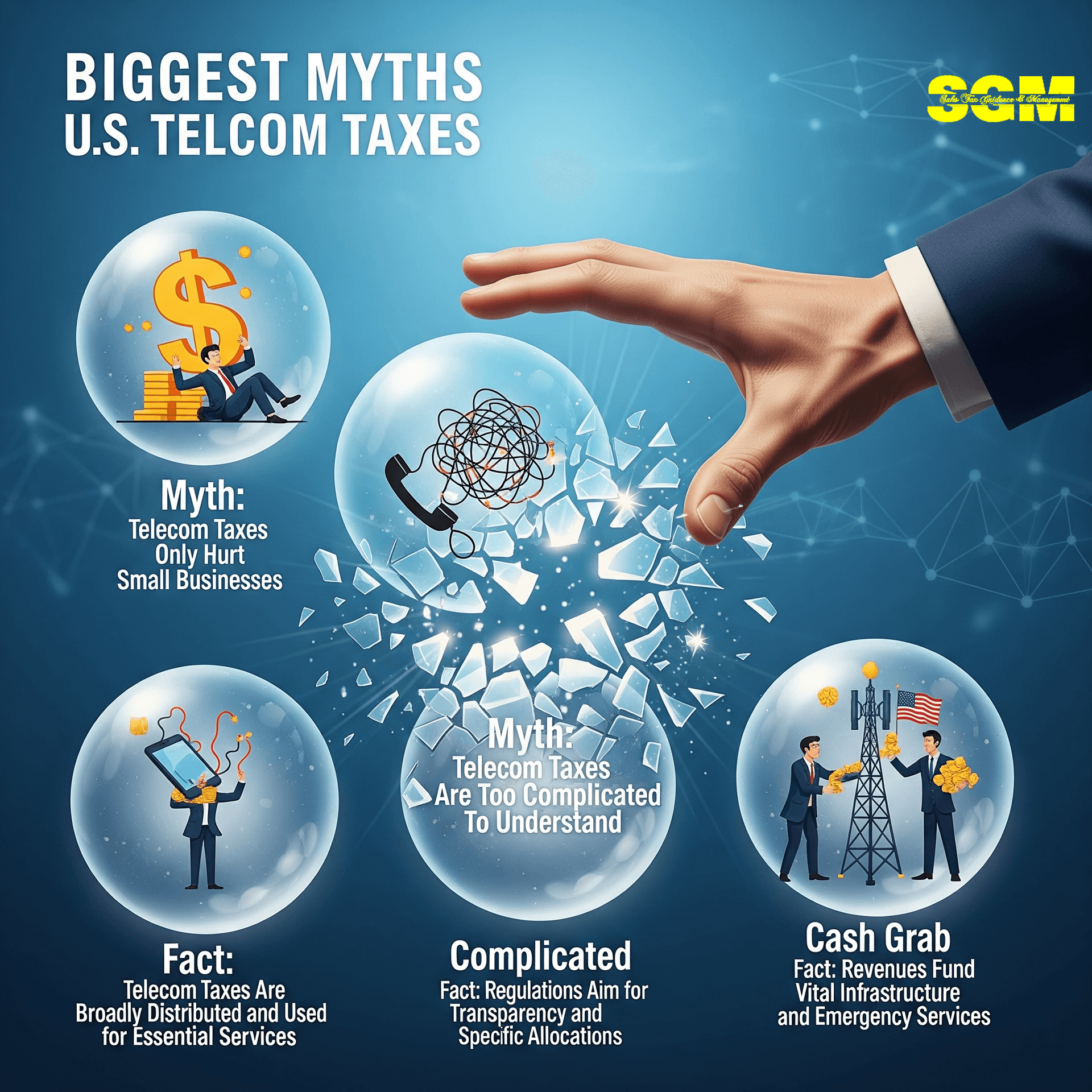
Telecom taxation in the U.S. is multi-layered and notoriously complex, creating ample room for confusion. Here are the most persistent myths and the real story behind them:
1. “VoIP is delivered over the internet, so it’s tax-free.”
Many mistakenly believe that because VoIP uses the internet, it’s exempt from taxation. That’s not the case. VoIP can be taxable depending on your jurisdiction even if it’s bundled or delivered digitally. The Internet Tax Freedom Act (ITFA) prohibits taxes on internet access, but it doesn’t exempt VoIP or similar telecom services.
2. “I’m a reseller or carrier; the taxes are being handled upstream.”
This is a dangerous misconception. Even if your suppliers pay certain taxes or fees such as the Universal Service Fund (USF), your business remains independently responsible for registering, collecting, and remitting taxes to the appropriate authorities.
3. “Internet access is tax-exempt, so all telecom and IP-based services are too.”
It’s more nuanced. The ITFA only exempts internet access services, not general IP or telecom services. Many IP-enabled services like VPNs, MPLS, or SD-WAN may still face regulation or taxation depending on how they’re classified and where they’re offered.
4. “The Federal Telephone Excise Tax is gone.”
While some long-distance and bundled telecom services were exempted following legal challenges, a 3% excise tax on certain local telecommunications services remains in force.
5. “Managing USF and local telecom taxes is prohibitively difficult.”
Though there’s a perception that calculating universal service contributions and local telecom taxes is daunting, regulatory frameworks and tools exist to simplify this process. USF contributions, for example, are based on revenue and a published factor, and many billing systems can automatically handle state and local tax calculations.
Why These Misconceptions Persist
Rapid technology convergence: Legacy tax laws lag behind new technologies like VoIP and broadband, creating ambiguity.
Jurisdictional complexity: Federal, state, and local governments each have unique tax frameworks.
Terminology confusion: Terms like “tax,” “fee,” or “regulatory charge” often appear interchangeably on bills, misleading both consumers and businesses.
Recommendations for Providers
Action | Why It Matters |
Classify your services correctly | Taxability varies by service type and region. |
Register proactively | Even resellers must register and remit directly. |
Invest in automated compliance tools | Streamlines billing and reduces errors. |
Consult tax experts when needed | Especially useful for ambiguous or bundled service offerings. |
Stay connect with SGM to ensure compliance with these new regulations.
Frequently Asked Questions
SGM Tax Services
SGM Tax Services supports businesses with specialized indirect tax compliance and advisory services, including complex multi-jurisdiction U.S. sales and use tax matters. Our team helps businesses navigate evolving tax rules, reduce compliance risk, and strengthen reporting accuracy across regulated industries.
Reviewed by Athul Prasobhan, COO, SGM Tax Services
Sources & References
Related Topics
Found this article helpful?
Share it with your network